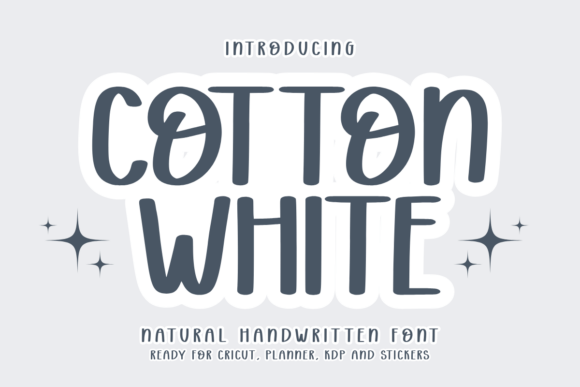
Cotton White: A Handwritten Font for Building a Warm Brand
There’s a moment in every small business when you realize your visuals need to catch up with your heart. Maybe it’s staring at a bland thank-you card template after a wonderful customer order, or feeling a pang of disappointment with a freshly printed menu that just doesn’t feel like your cozy café. It happened to me while designing new labels for a line of handmade candles. The clean, modern font I’d been using felt sterile, too corporate. My products were personal, crafted with care, but my branding didn’t whisper that story. That’s when a font like Cotton White becomes not just a design tool, but a branding solution.
How Cotton White Creates a Personal Feel for Product Labels
Cotton White is more than just another script handwritten font; it’s a specific mood. As a creative consultant, I’ve tested dozens of fonts for client projects, and the immediate impression of Cotton White is warmth. Its characters are “cute,” as described, but crucially, they’re clean and consistent. This balance is everything for a business. A purely messy, unpredictable handwriting font can look amateurish on a product label. Cotton White, however, offers that friendly, personal feel while maintaining a polished uniformity that customers subconsciously read as trustworthy. I applied it to candle jar labels, and the transformation was instant. The product name, rendered in Cotton White, suddenly felt like a hand-written note from the maker, inviting a personal connection before the customer even lit the candle.
Using Cotton White for KDP Interiors and Printable Journals
The application for planners and KDP (Kindle Direct Publishing) interiors is a perfect example of its niche. For authors or creators designing workbook interiors, a font that feels too rigid can make the exercises feel cold and clinical. Cotton White, woven into section headers or inspirational quotes within a journal, injects a human touch. It turns a printable from a mere document into a companion, as if the guide is gently handwritten just for the user. This Script Handwritten style, when used for supporting typography like chapter titles or margin notes, doesn’t sacrifice readability for style. Its open letterforms and clear baseline make it legible even at smaller sizes, which is essential for printed materials where space is limited.
Building Consistent Branding with Cotton White Fonts
Typography is the silent ambassador of your brand. A font used haphazardly across a menu, a social media graphic, and a shop banner creates visual chaos. Consistency builds recognition and professionalism. Cotton White excels as a brand’s primary display font—the hero typeface for your logo, product titles, and key headlines. Imagine a boutique clothing tag: the brand name in a sleek sans-serif might look high-end, but a boutique selling handmade, rustic-chic items might want a different emotion. Using Cotton White for the boutique name on the tag immediately communicates artisanal, cared-for, and personal. Then, for the practical information like size or material, you pair it with a simple, neutral sans-serif font. This pairing creates a hierarchy: the personality comes from the Cotton White fonts, and the clarity comes from its supporting partner. This system can then roll out consistently: the same pairing on your Instagram story templates, your online shop banner, and your packaging stickers, creating a cohesive world that customers remember.
Cotton White for T-Shirts and Cricut Crafts Merchandise
For businesses venturing into merchandise like t-shirts or using a Cricut for craft-based products, the font choice dictates the product’s appeal. A harsh, geometric font on a soft cotton tee can feel dissonant. Cotton White, with its gentle curves and approachable weight, looks like it was meant to be on fabric. It translates the “cute” and “warm” description directly into a wearable emotion. When testing it for a client’s café merch—a simple tee with the phrase “Good Coffee & Good Talk”—the Cotton White rendering made the slogan feel like an intimate invitation, not a loud advertisement. For Cricut projects, such as cutting vinyl for stickers or window decals, this font’s consistent stroke width and clear outlines ensure the cutting machine reads it accurately, resulting in a clean, professional final product that still carries that handmade charm.
Where Cotton White Works Best in Your Business Materials
Not every font is right for every job. Based on its design, Cotton White is ideal for display purposes—the elements you want to emphasize. It’s perfect for your logo, your product name on packaging, headers on your menu or website, and short, impactful phrases on social media graphics or digital ads. For longer body text, like a menu’s full description of dishes or the paragraphs on your website’s “About Us” page, it’s better to use a more readable serif or sans-serif font and let Cotton White shine in the titles. This preserves its special character without taxing your customer’s reading experience. On small labels, like those for mini skincare jars, use it for the product name only, at a size that remains clear. Its warmth will draw the eye, and the paired simple font will handle the ingredient list.
Before integrating any font like Cotton White into your commercial materials, always check the licensing details to ensure it covers your intended use—whether for physical products, online sales, or client work. Verify the file formats included to guarantee compatibility with your design software, whether for print or web. Explore if it includes stylistic alternates or ligatures, which can add even more personalized flair to your logo or key headings, making your application of this handwritten font uniquely yours.
The journey from a generic business visual to a branded one is often just a few thoughtful design choices. Cotton White isn’t a font that shouts; it’s one that smiles. It turns a product label into a greeting, a menu header into a welcome, and a t-shirt slogan into a shared sentiment. For the small business owner, the café operator, the candle maker, or the journal designer, it provides a ready-made personality—one of warmth, care, and personal touch—that can be applied consistently across every customer touchpoint. That consistency builds a recognizable, trustworthy, and ultimately memorable brand, starting with the simple, powerful act of choosing the right typeface.